Binance bStocks Show Why Tokenized Equities Need Better Swap Routing

Binance's move into U.S. stocks and planned bStocks is a clear signal that tokenized real-world assets are moving from narrative to user-facing product. The hard part now is not simply putting equities onchain. It is making the route from stablecoins, crypto assets, wallets, liquidity, and settlement rules understandable enough for normal users to trust.
Binance just made the stock-to-crypto boundary thinner
Binance announced on June 1, 2026 that eligible users can access more than 7,000 U.S.-listed stocks and ETFs from inside the Binance app. The launch is aimed at non-U.S. users and supports funding through crypto assets, with USDC as the primary purchase currency and support for assets including BNB, USDT, USD1, and $U.
That alone is a meaningful product shift. A crypto exchange adding stock and ETF access makes the account feel less like a single-market venue and more like a multi-asset financial hub. For global users, the appeal is obvious: fewer accounts, easier funding, fractional exposure, and a familiar interface.
But the more important long-term signal is Binance's preview of bStocks, tokenized securities planned for BNB Chain. Binance describes the product as a way to turn stock exposure into programmable, always-on onchain assets. That is where the story moves beyond brokerage access and into DeFi infrastructure.
Why bStocks matter for RWA adoption
Tokenized equities are part of a broader RWA trend: real-world financial assets are being represented onchain so they can move through crypto-native rails. Treasuries, money market funds, private credit, commodities, and equities are all pushing in the same direction.
The promise is simple. Users get easier access. Assets become more composable. Markets can operate across wallets, exchanges, DeFi protocols, lending venues, and liquidity pools. Instead of traditional market access sitting outside crypto, the asset can live closer to the rest of a user's portfolio.

That does not mean a tokenized equity is the same thing as directly owning a share. Binance's own announcement makes the distinction clear: bStocks are not stocks or shares and do not give holders direct ownership of the underlying listed company. That distinction matters because tokenized products carry legal, custody, market-hours, redemption, issuer, and jurisdictional assumptions.
For users, the interface may look simple. The product mechanics are not.
Access is only the first layer
The headline number is 7,000 U.S. stocks and ETFs. The deeper product question is what happens after access becomes abundant.
When a user wants to move from USDT to USDC, then into tokenized equity exposure, then back into crypto liquidity, the practical experience becomes a route problem. Which asset should be used for funding? Which venue gives the best execution? Where is the real liquidity? What happens if one path is cheap but slow, or fast but thin? What assumptions sit behind the tokenized instrument?
This is the same pattern DeFi has already seen with cross-chain swaps. A user does not only care that an asset is available. They care whether the route is reliable, priced well, and clear enough to evaluate.
Tokenized equities will create a similar need. If bStocks and other equity tokens become active across wallets, CEX rails, BNB Chain, and DeFi protocols, users will need routing that can explain more than price. They will need to understand availability, slippage, chain context, liquidity depth, wrapper risk, redemption logic, and the difference between direct exposure and tokenized representation.
Tokenized stocks could increase stablecoin routing pressure
Binance's funding design also points to another important trend: stablecoins are becoming the default bridge between crypto balances and traditional asset exposure.
If users can fund equity exposure with USDC, USDT, BNB, and other assets, then the swap experience before the stock purchase becomes part of the product. A user may not think of that as a swap. They may think, "I want to buy this ETF." Under the hood, the experience may involve asset conversion, liquidity selection, currency handling, settlement timing, and platform-specific rules.
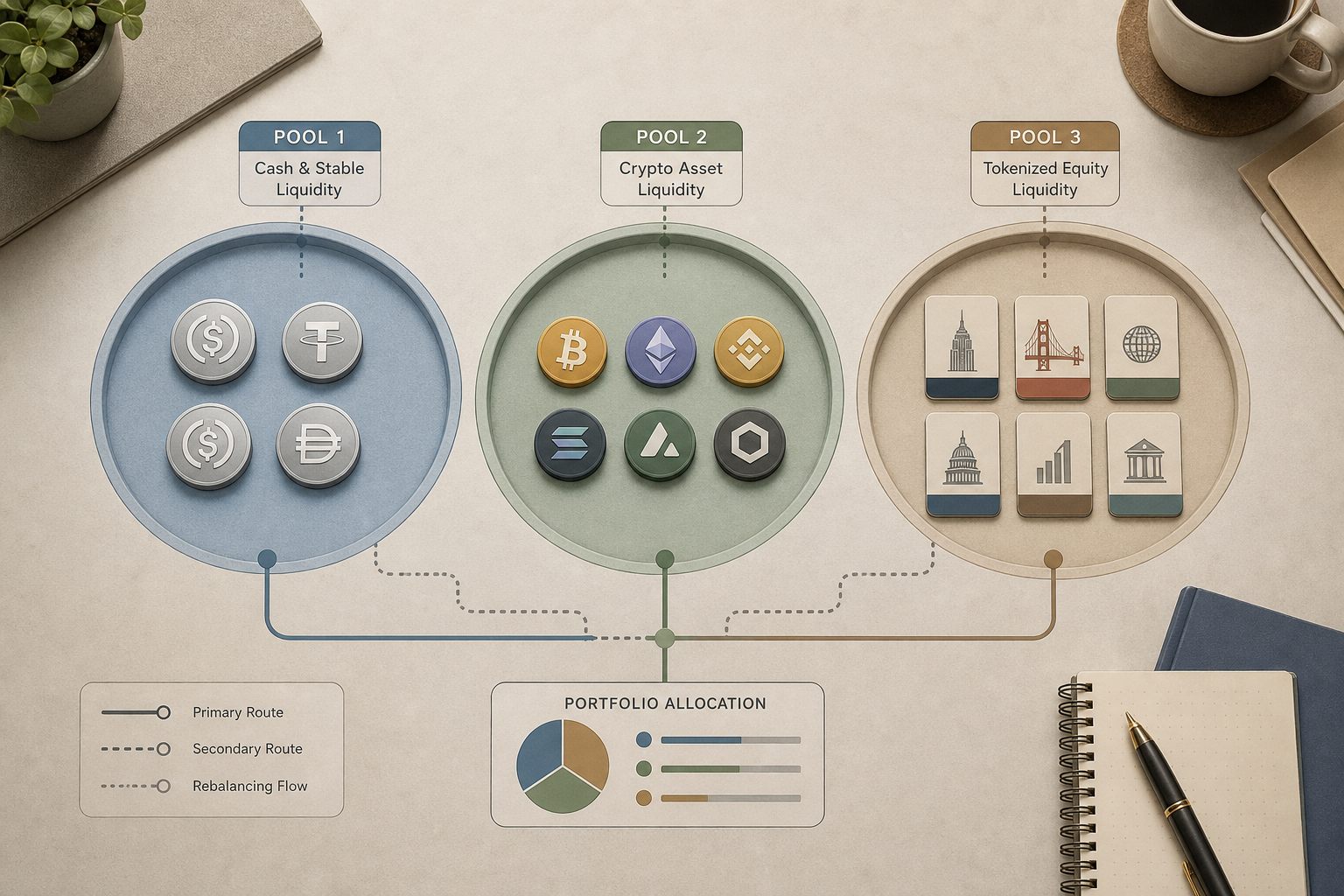
As more real-world assets move onchain, the market will not be split cleanly between "crypto trades" and "TradFi trades." Instead, users will move through blended paths. Stablecoin to tokenized equity. Tokenized treasury to crypto asset. Wrapped stock exposure to DeFi collateral. Exchange balance to wallet balance. Each path adds execution questions.
That is why routing quality becomes strategic. The best product will not be the one with the longest asset list. It will be the one that helps users move between assets with the least confusion and the best execution context.
The next competition is clarity
Binance is not alone in chasing the everything-exchange model. Coinbase, Kraken, Robinhood, and tokenization-focused protocols are all moving toward broader asset coverage. The difference will increasingly come down to user experience and trust.
For tokenized equities, trust has several layers:
- clear asset definitions
- transparent issuer and custody structure
- practical liquidity
- reliable funding paths
- visible fees and spreads
- accurate redemption or conversion assumptions
- routing that does not hide important tradeoffs
DeFi users are used to hunting for routes across DEXs and bridges. Mainstream users are not. If tokenized stocks become a consumer product, routing and execution clarity cannot stay hidden behind technical language.
This is where the market is heading. Asset access is becoming easier. The bottleneck is shifting to decision support.
What OneSwap is watching
At OneSwap, we see Binance's bStocks preview as another sign that the future of swapping is multi-asset, not just multi-chain.
Users will not only move between ETH, BTC, stablecoins, and long-tail tokens. They will increasingly move between crypto assets, stablecoins, RWAs, tokenized funds, and tokenized equity exposure. In that world, swap routing needs to do more than find a path. It needs to help users understand the path.
OneSwap is building for that reality: cleaner route discovery, better execution context, and a simpler way to move through fragmented liquidity without forcing users to become infrastructure analysts.
If tokenized equities are going to be useful beyond headlines, users need routes they can understand and trust.
Explore smarter swap routing at OneSwap.ai.
Artículos relacionados

Tokenized Stocks Are Entering DeFi Collateral, So Routes Need Market-Hour Context

USD1's Mesh Expansion Shows Why Stablecoin Routing Must Follow the User