
Native Stablecoins Are Turning Route Selection Into an Asset Identity Problem
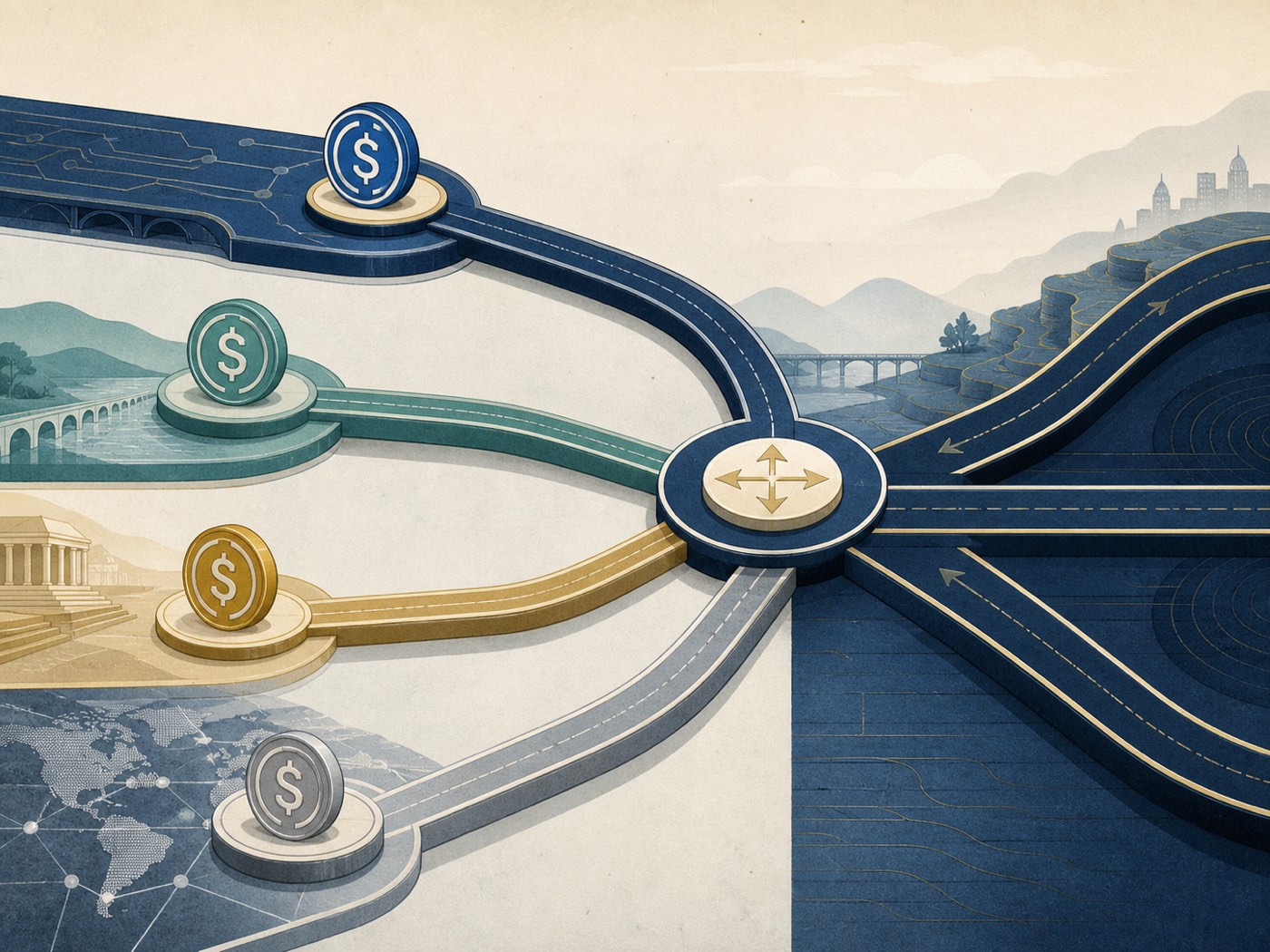
A stablecoin ticker tells you the brand. A usable route needs the chain, contract, settlement rail, liquidity, and operating controls.
On August 25, World Liberty Financial announced that USD1 is now issued natively on the Canton Network. The company said USD1 has passed $4 billion in circulation, while the announcement positioned Canton as a network handling institutional tokenized assets and settlement workflows.
The same 48-hour window brought another signal. Watcher.Guru reported on X that JPMorgan, Bank of America, Wells Fargo, Santander, and more than a dozen financial institutions were moving forward with plans for a crypto stablecoin. The report describes a developing commercial initiative, while JPMorgan's own path remains preliminary.
Together, these updates point to a bigger route-selection problem. Dollar assets are gaining more issuers, more networks, and more settlement environments. A quote that displays only a ticker and a price leaves out the details that determine whether the route can actually settle.
Native issuance changes the route
Native issuance gives an asset a direct home on a network. USD1's Canton launch places the token on a chain designed for institutional workflows, with privacy and permissioning controls that can apply to the transaction. The Business Wire announcement says USD1 can serve as the dollar leg for tokenized real-world assets, derivatives collateral, institutional lending, payments, and issuance or redemption flows.
That setup carries a different execution profile from a representation moved across a bridge. The user may see the same ticker in a wallet or search result, yet the route can lead through different contracts, issuers, redemption processes, message layers, and liquidity venues.
Native availability can improve settlement fit for a particular network. It also adds another asset instance for a router to identify and compare. The route engine needs to know which version the destination accepts, where liquidity sits, how the token can be redeemed, and which controls can delay or reject a transaction.

One symbol can describe several execution paths
Stablecoin symbols are useful discovery labels. They are weak settlement identifiers on their own.
The exact route depends on details such as:
- the token contract and network
- native issuance or bridged representation
- issuer and redemption path
- source and destination wallet support
- liquidity pool or market used for conversion
- bridge, messaging, or settlement dependency
- transfer restrictions and permission checks
- finality expectations and network fees
These fields change the user's outcome. A USD1 balance on one network can have a deep market and a direct destination transfer. A similarly named balance on another network can require a bridge, a conversion, or an issuer-supported mint and redemption step.
The price can look close while the operational path differs materially. A route with a smaller quoted spread may carry an extra bridge step, thinner liquidity, slower finality, or a destination that accepts a different token contract. A route with a slightly higher fee can settle directly with clearer support and fewer dependencies.
The cash leg now has venue context
Tokenized assets receive most of the attention when a new institutional network launches. The cash leg determines how those assets trade, settle, and leave the system.
The Canton announcement describes USD1 settling alongside a tokenized asset in one synchronized transaction. That relationship can reduce timing gaps inside Canton. It does not make USD1 interchangeable across every network or application. The route still needs to establish where the asset exists, what the destination accepts, and how liquidity crosses the boundary.
This is a familiar issue in cross-chain swaps. A user chooses an asset pair, while the infrastructure chooses a chain-specific representation and a sequence of actions. Native settlement may be ideal for a Canton transaction. A different representation may have deeper liquidity on another network. An aggregator has to compare those paths using live data rather than a single global balance for the symbol.
Banks add more settlement assets to the map
The X discussion around a possible bank stablecoin consortium adds a second source of fragmentation. A large bank-backed asset may emphasize commercial payments, approved counterparties, or region-specific settlement. A public stablecoin may emphasize permissionless liquidity, exchange availability, or broad wallet support. Each design creates a different route surface.
The commercial use case also creates more currency and jurisdiction dimensions. Reporting on the bank discussions describes a dollar-first plan with possible expansion to euros and other G7 currencies. That would give routing systems more settlement choices and more conditions to evaluate.
The outcome for users is practical. They will encounter more assets that look like dollars while carrying different issuer risk, access rules, transfer paths, and liquidity. Wallets and applications will need to identify the exact asset before initiating a transfer or swap.
Route quality depends on asset identity
A route engine should attach asset identity to every quote. A useful quote can include:
Exact asset
Show the network, contract address, decimals, issuer, and native or bridged status. The user should be able to confirm which asset enters and leaves the route.
Settlement fit
Show whether the destination accepts that exact token. If a conversion or bridge is required, show it as a route step with its fee, expected time, and dependency.
Liquidity context
Show the venue or pool that supplies the rate, the available depth, expected price impact, and any capacity limit. A stablecoin label does not reveal the market supporting the quote.
Control context
Show permission checks, transfer restrictions, issuer status, bridge status, and relevant settlement gates. A route can have a valid price while its next action waits for an operational approval.
Time and cost
Show network gas, protocol fees, bridge fees, finality expectations, and the timestamp of the status check. These details let the user compare the complete execution path.

A practical pre-quote checklist
Before displaying a cross-chain stablecoin route, the routing layer can answer five questions:
- Which exact token contract does the source wallet hold?
- Which exact token contract does the destination application accept?
- Can the route use native liquidity, or does it need a bridge or conversion?
- Which venue, issuer, or message layer controls the next step?
- What current status, fee, depth, and finality data support the quote?
This checklist turns asset identity into an execution field. It also creates a better support trail. When a transfer waits, the team can see whether the delay comes from the network, a bridge, a pool, an issuer control, or destination acceptance.
Sources and reporting context
- World Liberty Financial and Canton announcement
- Cointelegraph coverage of native USD1 on Canton
- Watcher.Guru X report on bank stablecoin plans
The route becomes the product surface
Stablecoin growth expands the set of useful settlement paths. Native issuance improves the fit between an asset and its home network. Bank participation may add trusted commercial rails and new regional instruments. These developments increase the value of a routing layer that can compare exact execution paths.
The strongest route is the one a user can understand and complete. Price matters. Asset identity, liquidity, settlement controls, destination fit, and current status determine whether that price leads to a successful outcome.
OneSwap makes asset identity part of the decision
OneSwap helps users compare cross-chain execution across networks, assets, liquidity, fees, and slippage. As more dollar assets move onto more networks, the route view needs to carry the exact token and the conditions around its settlement path.
Native USD1 on Canton shows how the cash leg can become a network-native product. The next generation of route comparison will make that distinction visible before the user confirms a swap.
Explore smoother cross-asset execution at OneSwap and review the route details before you confirm a swap.
Articles connexes

Ripple's AI Payment Kit Turns Agent Commerce Into a Routing Test

Hyundai Card's Avalanche Pilot Turns Stablecoin Speed Into a Scaling Test