
x402 Machine Payments Make Stablecoin Routing an Execution Problem

x402 turns an HTTP request into a payment request. As software starts paying for data, compute, and APIs across networks, stablecoin routing becomes part of product execution quality.
Recent activity around x402 shows machine payments moving from protocol demos into visible user flows. Erik Voorhees described an agent discovering Apify and using an x402 payment to access a service. Solana Hub highlighted an autonomous purchasing agent and x402 payments on Solana. Token Terminal reported 17.8 million USDC transfers across Base, Polygon, Solana, and Algorand through x402 over the prior 30 days.
These signals connect agentic commerce to a familiar cross-chain problem: a payment request still needs a reliable route. The software may know the dollar amount, yet it still has to choose a network, an asset contract, a settlement method, a fee budget, and a recovery path.
x402 turns a payment into a route decision
x402 revives HTTP status code 402, Payment Required, for internet-native payments. A resource server returns payment requirements. The client selects a supported scheme and network, creates a payment payload, and retries the request with proof of payment. The x402 documentation describes network identifiers, supported tokens, and transfer methods across several ecosystems.
That flow gives software a clean payment handshake. It also exposes the route decision inside the handshake. A machine needs an exact answer to questions that human users often resolve through a wallet prompt:
- Which network should settle the payment?
- Which token contract is accepted at the destination?
- Which payment method fits the wallet and facilitator?
- What is the total cost after conversion, gas, and slippage?
- What should happen when the preferred route becomes unavailable?
A request priced at one dollar can have very different execution paths. The amount is only the starting point.
Stablecoins become network-specific execution choices
USDC is a useful example because the unit is familiar while the execution context changes by network. A wallet can hold USDC on Base, Arbitrum, Polygon, Solana, or another supported chain. Each balance has a different contract or token address, transaction model, confirmation profile, and set of venues.
The Coinbase x402 overview describes programmatic stablecoin payments for both people and AI agents, including EVM networks and Solana. The x402 network support guide uses CAIP-2 identifiers so a client can distinguish networks explicitly and select transfer methods such as EIP-3009 for compatible tokens or Permit2 for broader ERC-20 support.
That distinction matters for route quality. A source wallet may have enough USDC in total while holding the wrong network balance for the requested service. A bridged token may share the same ticker while a venue accepts the native deployment. A route may show a low quoted fee while the final destination requires another conversion before the service can use the funds.

Fresh x402 signals point to multichain demand
The recent X conversation shows several versions of the same demand pattern.
First, Erik Voorhees described an agent using x402 with Apify after the agent discovered that the service accepted programmatic payment. The interaction compressed discovery, authorization, and settlement into one software flow.
Second, Solana Hub highlighted an autonomous purchasing agent and x402 payments on Solana. This expands the use case beyond a single chain and puts payment availability inside an application workflow.
Third, Token Terminal reported 17.8 million USDC transfers across Base, Polygon, Solana, and Algorand through x402 over the prior 30 days. A recent Base example shows autonomous mining infrastructure settling small USDC payments without API keys or manual account steps.
Together, these examples make the routing requirement concrete. An agent must discover a service, interpret supported payment requirements, maintain a usable balance, select a chain, and settle within the service's timing window. The payment rail and the route planner become closely connected.
Agent-grade routing needs five live inputs
Exact asset identity
A route should identify the token by chain and contract, alongside its symbol and decimals. This prevents a familiar ticker from hiding a network-specific deployment or a bridged version with different redemption conditions.
Destination compatibility
The destination service, exchange, pool, or contract must accept the selected asset on the selected network. The route should verify the final input rather than assume that a symbol match completes the job.
Total execution cost
The useful number is the delivered amount after swap price impact, bridge or facilitator charges, network fees, and any extra conversion. A low headline fee can still produce a poor result when the route uses shallow liquidity or an unnecessary hop.
Settlement reliability
Agents operate inside time-sensitive workflows. A route score should include expected confirmation time, message delivery state, facilitator availability, and the chance that a retry produces a duplicate payment or a stale authorization.
Fallback and policy
The agent needs a bounded fallback policy. It can choose a second supported network, request a different token, wait for a route to recover, or return a clear failure state. The policy should respect amount limits, approved chains, and the service's payment requirements.
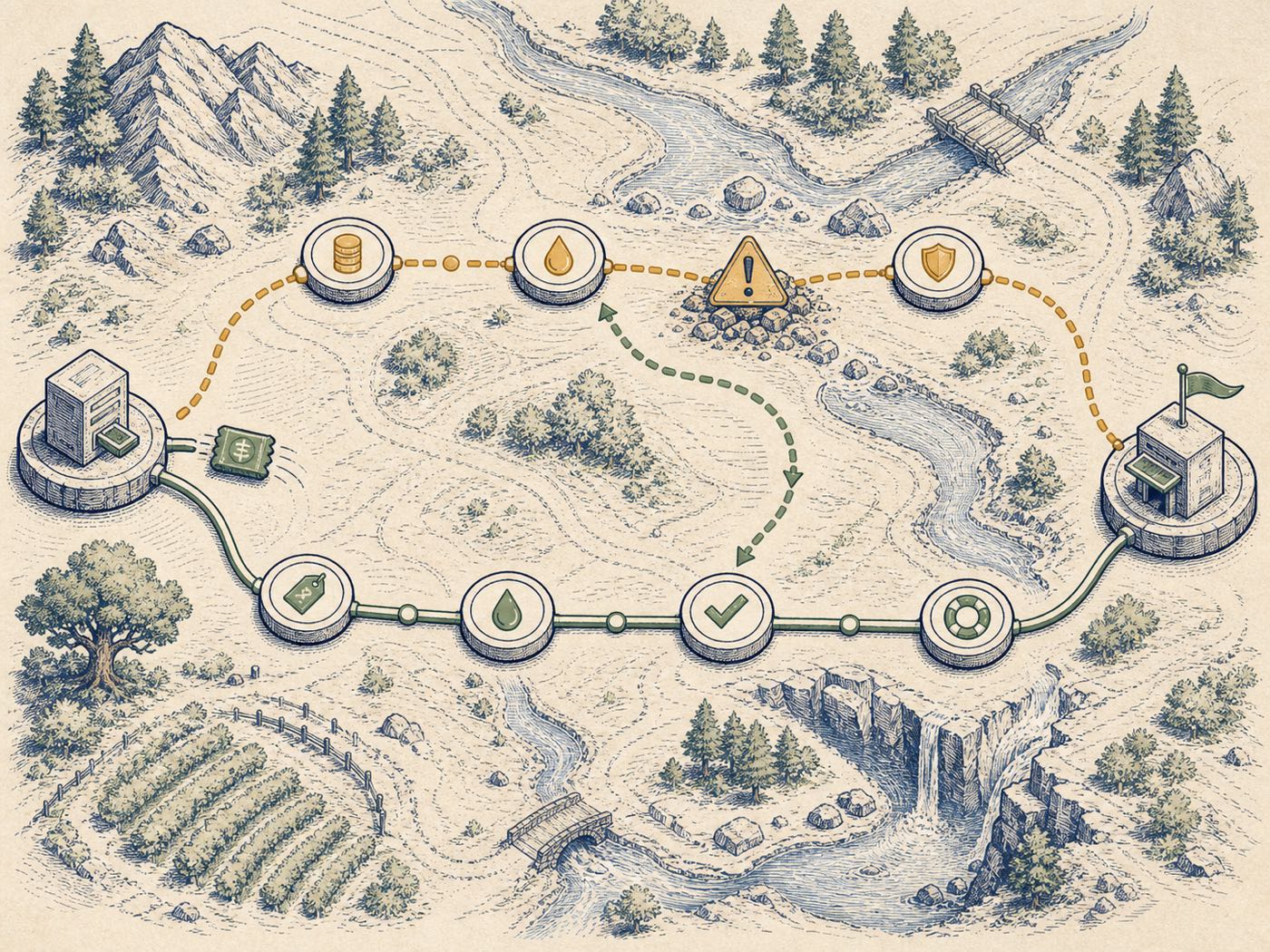
A failure-aware payment route protects the whole workflow
A route engine for machine payments should perform a preflight check before signing. It should fetch the server's payment requirements, match them against the wallet's balances and policies, and compare executable paths. The check should include the exact token, chain, transfer method, quote expiry, and expected settlement time.
The engine should then monitor the payment after submission. A transaction hash alone does not prove that the service received usable funds. The route should confirm the required network state, watch for facilitator or bridge status changes, and distinguish a pending payment from a failed or rejected payment.
This creates a practical recovery loop:
- Read the service's accepted payment requirements.
- Build candidate routes from the wallet's actual balances.
- Compare delivered value, total cost, and settlement time.
- Submit the route that satisfies the policy and destination.
- Confirm settlement and retry only when the payment state allows it.
- Explain the selected path and any fallback decision.
The same workflow applies to API access, compute markets, data services, trading tools, and cross-chain swaps. Every automated payment becomes a small execution decision with real liquidity and settlement consequences.
OneSwap can make route context visible
OneSwap gives users a way to compare cross-chain execution around networks, assets, liquidity, fees, and slippage. That context also fits the agentic payment loop. A machine can use route data to select a destination-compatible asset, price the conversion, evaluate settlement conditions, and keep a fallback available when the first path changes.
The x402 trend points toward software that can discover and pay for services on demand. Reliable adoption will depend on execution details that stay visible at the moment of payment. Route context turns a stablecoin balance into a usable payment choice.
Explore smoother cross-asset execution at OneSwap and review the route details before you confirm a swap.
Articles connexes

Tokenized Stocks Are Entering DeFi Collateral, So Routes Need Market-Hour Context

USD1's Mesh Expansion Shows Why Stablecoin Routing Must Follow the User