The Same Stablecoin Can Serve Three Markets, So Routes Need Context
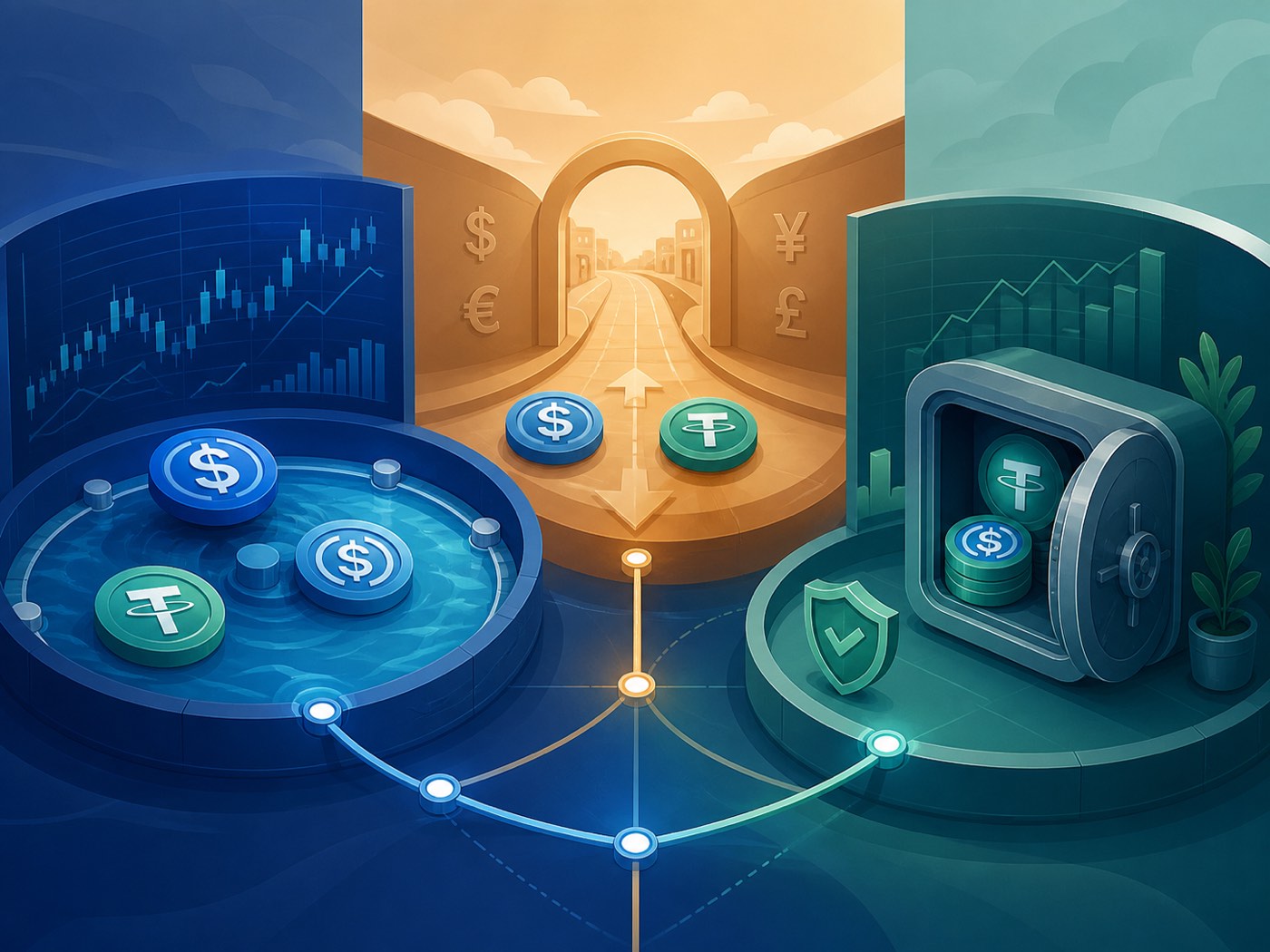
Stablecoins are becoming products with different jobs on different chains. A route needs to understand the job before it chooses the path.
Stablecoin growth is spreading across different jobs
Fresh activity on X makes the shift visible. On August 17, Circle shared that EURC had passed €400 million in circulation after supply grew more than 100% over the previous year. The post connected that growth with exchanges, payments, and institutional workflows. Read Circle's post on X.
Circle's EURC product page lists Avalanche, Base, Ethereum, Solana, and Stellar as supported networks. It describes EURC as a euro-backed asset used in FX markets, DeFi, and cross-border payments, with a path between EURC and USDC for eligible Circle Mint customers. See Circle's EURC overview.
Dune's July stablecoin research measured about $312 billion across more than 200 tokens. USDT and USDC represented roughly 83% of circulating supply, while the activity around each token varied sharply by chain and venue. Read Dune's behavioral map of stablecoins.
The market is expanding across several kinds of work. A stablecoin can provide trading collateral, a payment balance, a settlement instrument, or a yield position. Each job creates a different route requirement.
The chain changes the product a user receives
The ticker gives a familiar label. The chain, contract, venue, and flow determine the practical product.
- USDT on Tron: Dune's data shows broad holder distribution and mostly plain transfers. That pattern fits payment and remittance flows.
- USDC on Base: The pair turns over quickly and much of its identified flow comes from DEX liquidity and flash loans. That pattern fits trading infrastructure and collateral movement.
- USDC on Ethereum: The asset spans ordinary wallets, exchanges, and DeFi venues, creating a wider mix of settlement and market activity.
- USDe and USDS: Supply sits heavily in yield contracts, so the route needs to preserve the user's yield or savings intent.
The same symbol can therefore lead to different outcomes across networks. The recipient may need a payment-friendly balance, a deep trading pair, or a token accepted by a specific lending market. A route that delivers the wrong representation creates extra conversion work even when the displayed ticker looks correct.

Headline volume can hide the route underneath
Stablecoin transfer volume measures movement. It does not fully describe the economic job behind that movement.
Talos and Coin Metrics examined USDC on Base after January 2026 adjusted transfer volume reached a record level. The report found about $5.3 trillion in January transaction volume on Base, with roughly half of that activity linked to Aerodrome liquidity pools, Morpho, LP rebalancing, and flash-loan mechanics. A dollar cycling through a liquidity range has a different intent from a dollar settling a cross-border payment. Read the Talos analysis.
Recent X discussion points in the same direction. Arkadia0x highlighted the difference between stablecoin volume and real-world adoption, citing concentrated USDC activity on Base. See the X discussion. Nick Research described a broader product trend in which crypto infrastructure fades into the background while users care less about chains, bridges, wallets, and gas. Read the post.
The route engine needs this context before it ranks options. Useful route fields include:
- Exact asset identity: issuer, token contract, decimals, native or bridged status, and source chain.
- Destination fit: the asset and network that the recipient, exchange, payment rail, or protocol accepts.
- Liquidity role: DEX pool, order book, RFQ provider, bridge liquidity, lending market, or payment rail.
- Economic intent: trading, spending, settlement, collateral, or yield.
- Execution result: price impact, gas, pool fees, bridge fees, service charges, final amount, and settlement time.
These fields make the quote useful beyond a single output number. They also give automated systems enough information to choose a route that matches the user's actual goal.
Route selection should start with the destination
A user who wants to pay a supplier needs a spendable destination balance. A trader needs depth and a clean market pair. A treasury team needs predictable settlement and clear counterparty conditions. A yield strategy needs the supported contract and the position's expected behavior after arrival.
The same starting balance can serve each goal. The best route changes with the destination and the deadline.
A route-aware quote can keep the interface simple while showing the fields that change the outcome:
- source asset and source network
- destination asset and destination network
- direct transfer, bridge, pool, or multi-hop path
- liquidity source and expected price impact
- total fees and net amount received
- confirmation and finality estimate
- destination compatibility and next-use status
This structure helps a user compare a cheap path with a usable path. It also makes route changes easier to explain when liquidity, fees, or network conditions move.

OneSwap can make stablecoin context legible
The expansion of stablecoin use creates a larger set of possible outcomes behind a simple swap form. OneSwap helps users compare cross-asset and cross-chain paths while keeping the source, destination, liquidity, fees, and settlement context visible.
The useful experience begins with the user's intended outcome. The route can then select the asset representation, network, venue, and transfer method that support that outcome. The user sees what will arrive, where it will arrive, how much it will cost, and how the asset can be used next.
As stablecoins serve more markets, route quality will depend on context as much as price. Explore smoother cross-asset execution at OneSwap.
Sources and data notes
- Circle's EURC post on X
- Circle EURC overview
- Dune: A Behavioral Map of Stablecoins
- Talos: The Curious Case of USDC on Base
- Arkadia0x on stablecoin volume and adoption
- Nick Research on invisible crypto infrastructure
Originally researched and drafted on August 18, 2026 using public X activity and public source material.