
Institutional Stablecoin Payments Need Better Route Clarity

Stablecoin payments are no longer just a crypto-native workaround. They are becoming part of how banks, payment companies, exchanges, and global brands think about settlement. That makes the next user problem very practical: not whether money can move onchain, but whether the route is clear enough to trust.
Stablecoin payments are becoming an institutional workflow
The latest market conversation around stablecoins is not only about market cap, regulation, or which issuer is growing fastest. The more important shift is that stablecoin-style settlement is moving into institutional workflows.
On X this week, several high-engagement posts pointed in the same direction. Swift and tokenized deposits were back in the conversation. Hyundai stablecoin payment testing on Avalanche drew attention. Stellar highlighted the efficiency argument for MoneyGram and stablecoin rails. None of these signals are identical, but together they show the same pattern: payments are becoming a core blockchain use case again.
This is different from the old "crypto payments will replace cards tomorrow" story. The stronger version is more specific. Institutions want faster settlement. Treasury teams want lower friction across borders. Users want to move value without waiting on slow banking windows. Payment networks want 24/7 rails. Stablecoins, tokenized deposits, and tokenized settlement assets all point toward that same operating model.
The challenge is that better rails do not automatically create a better user experience.
Faster rails still create routing questions
When a payment is simple, routing feels invisible. A user sends money, the receiver gets money, and the product hides the path.
Stablecoin payments are rarely that simple under the hood. The path can involve asset selection, chain selection, bridge assumptions, liquidity depth, venue choice, gas costs, issuer risk, wallet compatibility, and settlement timing. A payment may look like "send dollars," but the real execution question can be much more layered.
Is the user sending USDC, USDT, a bank tokenized deposit, or another dollar asset? Which chain is available on both sides? Is there enough liquidity if conversion is needed? Does the route require a bridge? Is a centralized venue involved? What happens if the cheapest route has the weakest settlement assumptions?
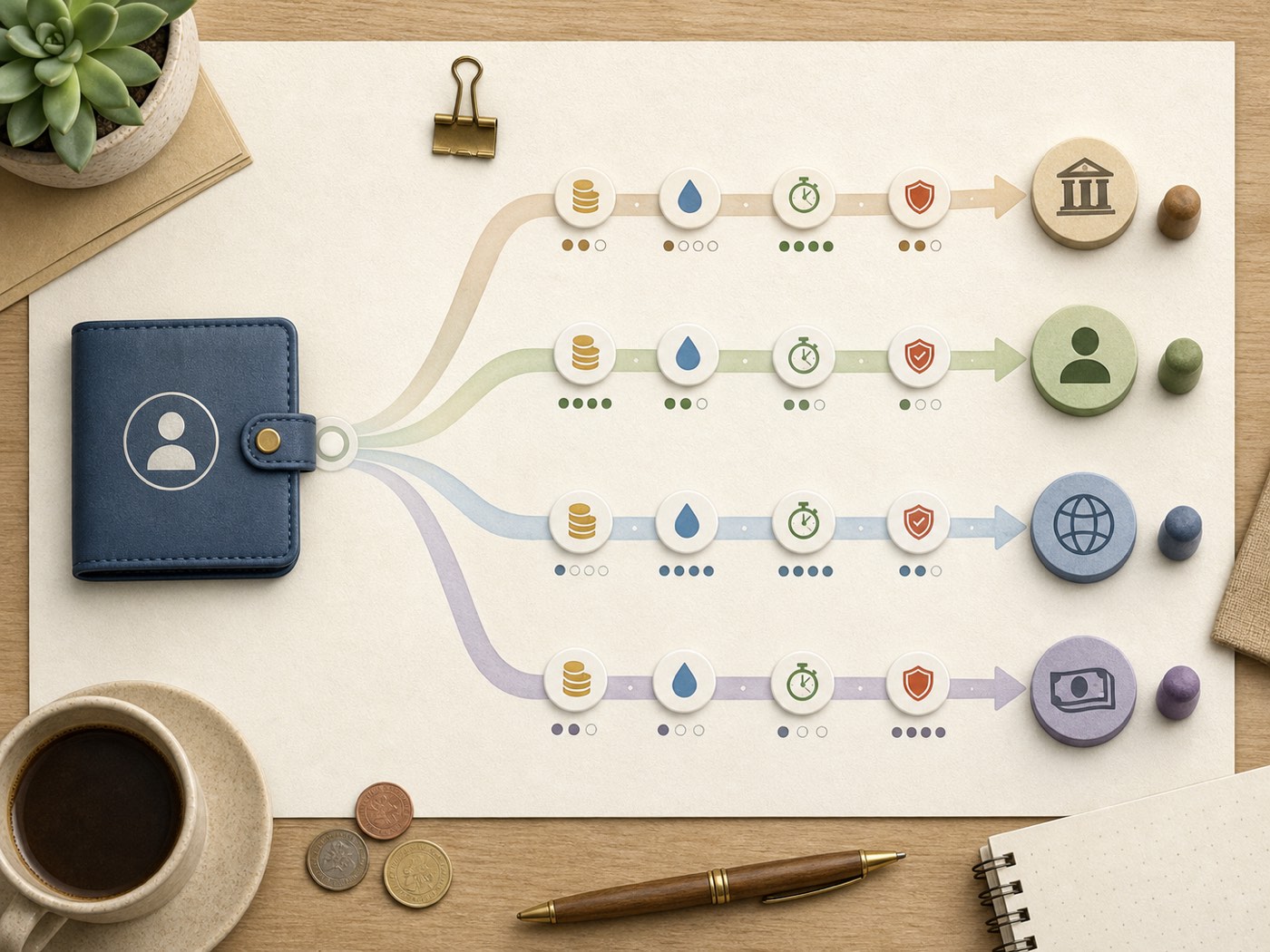
This is where payment UX and swap UX start to overlap. A payment product might not call itself a swap interface, but if it has to move between assets, chains, or liquidity venues, routing quality becomes part of the product.
Tokenized deposits add another layer
Tokenized deposits are not the same as public stablecoins. They usually represent commercial bank deposits on permissioned or institutionally controlled rails. That can make them attractive for regulated finance because the banking relationship, compliance model, and credit profile are familiar.
But from a user and product perspective, tokenized deposits still add a new route layer. If a user wants to move from a tokenized bank deposit into a public stablecoin, from a stablecoin into a tokenized fund, or from a tokenized asset back into exchange liquidity, the route matters.
The broader institutional trend is clear. Banks are exploring tokenized deposit networks. Central bank and commercial bank experiments are testing cross-border settlement with tokenized money. Tokenized assets are increasingly paired with faster payment settlement. The market is not moving toward one clean rail. It is moving toward many rails that need to interoperate.
That means users will need better visibility into execution. A route is not only a line between point A and point B. It is a set of assumptions about liquidity, settlement, speed, cost, and risk.
Enterprise adoption does not remove user risk
Institutional adoption can make stablecoin payments feel safer, but it does not remove the need for route clarity.
Enterprise pilots usually happen in controlled environments. They have defined counterparties, known settlement rules, and operational teams watching the flow. Retail and DeFi users do not get that same cushion. They often move through fragmented wallets, bridges, DEXs, exchanges, and chains.
That fragmentation creates practical risks:
- the asset is available, but liquidity is thin
- the route is cheap, but settlement is slower
- the chain is fast, but the receiver does not support it
- the bridge works, but adds an extra trust assumption
- the quote looks good, but slippage changes the result
- the user does not know whether the route depends on wrapped assets
These are not abstract concerns. They are the difference between a payment that feels instant and a payment that creates support tickets.
The next product layer is route clarity
Stablecoins became popular because they made crypto easier to use as money. But once stablecoin payments spread across more chains, banks, exchanges, apps, and enterprise systems, the experience becomes harder to explain.
The winning products will not simply say "we support stablecoins." Support is the baseline. The stronger product will show users how a route works before they commit.
That means clear comparison across:
- total cost
- expected settlement time
- supported chains
- liquidity depth
- bridge or wrapper exposure
- asset issuer assumptions
- failure and fallback paths

For stablecoin payments to scale, users need more than speed. They need confidence that the route they picked is the right route for the job.
What OneSwap is watching
At OneSwap, we see institutional stablecoin activity as a signal that swap routing will matter beyond trading.
The same route questions that already matter in DeFi will matter in payments, tokenized deposits, RWAs, and cross-border settlement. Users will move between wallets, stablecoins, tokenized assets, bridges, and liquidity venues without wanting to become infrastructure analysts.
OneSwap is built for that reality. Better route discovery is not just about finding a path. It is about giving users enough execution context to understand the path.
As stablecoin payments become more serious, route clarity becomes a product feature.
Explore smarter swap routing at OneSwap.ai.