KRW1 on Aptos Shows Why Stablecoin Routes Need Context

A stablecoin can reach a new chain in one announcement. Usable liquidity takes a route.
Aptos recently highlighted BDACS's KRW1 deployment on X, describing it as the Korean-won stablecoin's first non-EVM integration. The announcement connects KRW1 with payments, business settlement, and real-world asset tokenization across the Aptos ecosystem.
BDACS's official release and independent coverage describe the same expansion. KRW1 is moving into a Move-based environment after earlier multi-chain work, giving users and builders another place to hold, spend, trade, and settle a local-currency asset.
That change creates a useful product question for every cross-chain swap interface: what should a user see when a stablecoin exists across different execution environments with different contracts, liquidity venues, transfer methods, and next-use options?
A local stablecoin is becoming a multi-chain asset
A Korean-won stablecoin can begin with a clear local purpose. A user may want to pay, settle an invoice, move treasury value, or access a tokenized real-world asset. As the asset expands across networks, the original currency label stays familiar while the execution choices multiply.
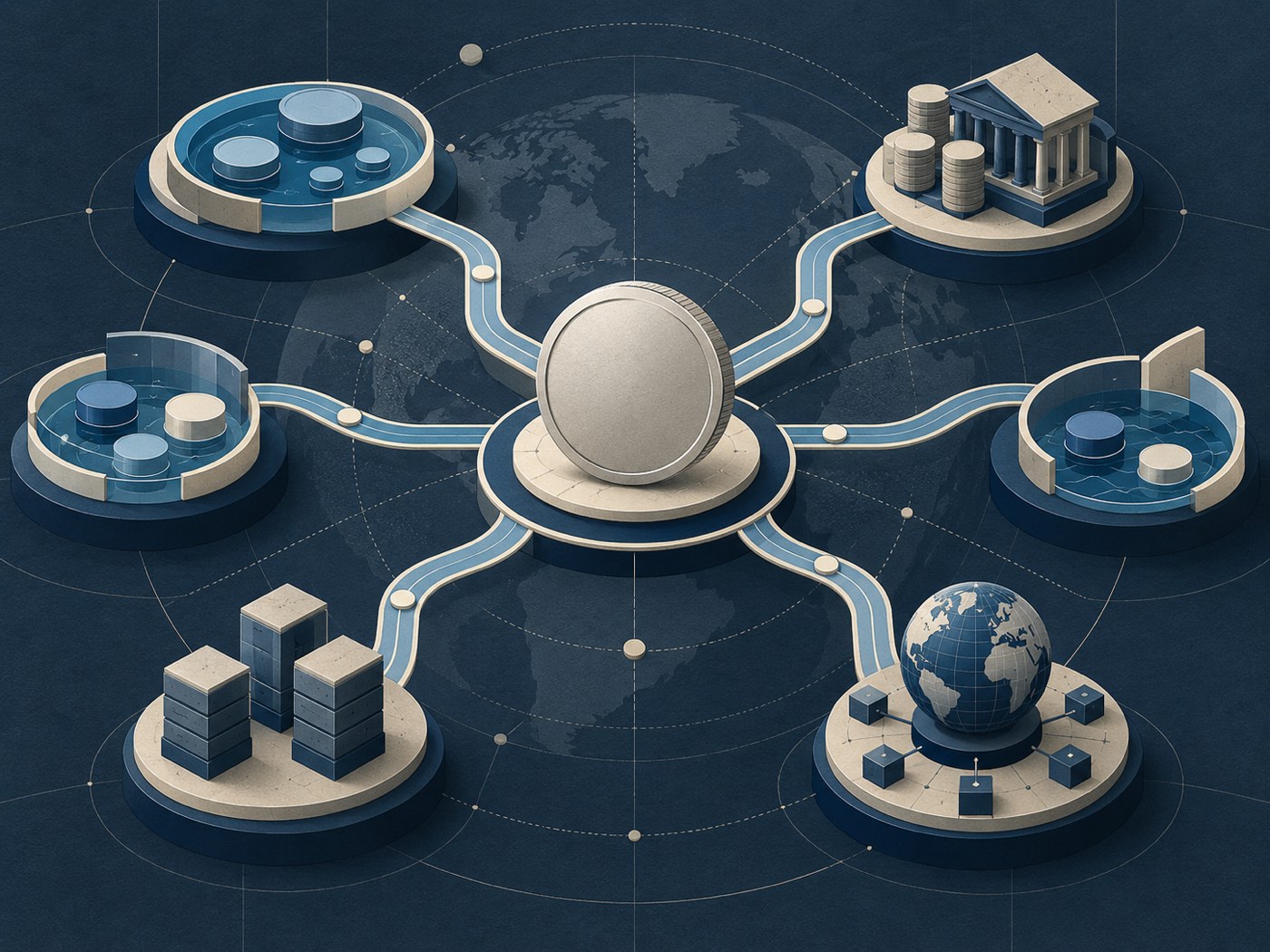
KRW1's Aptos deployment adds a Move-based network to a route map that already includes EVM-oriented environments. The network and token combination now carries more meaning than the ticker alone. A route engine needs to identify the exact asset, the chain that holds it, the pool or transfer system that moves it, and the application that can accept it at the destination.
The Aptos partnership also gives the expansion a practical direction. The companies describe payment rails, wallet infrastructure, everyday transactions, business-to-business settlement, and RWA tokenization. Each use case creates a different definition of a good route.
A payment route can prioritize predictable arrival and spendability. A treasury route can prioritize finality, limits, and operational controls. A DeFi route can prioritize pool depth and composability. An RWA route can prioritize eligibility, settlement asset, and the ability to reach the next regulated venue.
The first non-EVM integration changes the route map
EVM liquidity has familiar conventions for token contracts, approvals, gas assets, pool interfaces, and bridge systems. A Move-based chain introduces a different execution environment and a different set of integration points.
That difference affects the quote even when the currency label stays the same. The route may need to answer:
- Which KRW1 representation is held on the source chain?
- Which KRW1 representation is available on Aptos?
- Does the transfer use a canonical bridge, a messaging layer, a liquidity provider, or an issuer-supported process?
- Where does the deepest usable liquidity sit for the requested size?
- Which asset arrives in the destination wallet after the route completes?
- Can the user spend, trade, lend, or settle that asset immediately?
A ticker gives the user a starting point. The route gives the user an executable plan.

The practical risk sits in the gaps between those fields. A route can display an attractive price while using a thin pool. A transfer can complete on the destination chain while delivering a representation that a payment or RWA application does not support. A fast bridge can still create a poor result when the final venue lacks depth.
Route quality therefore depends on the full sequence. The visible output is one data point inside a chain of identity, liquidity, transfer, execution, and settlement decisions.
Payment rails create a destination problem
The Aptos and BDACS announcements emphasize on-chain commerce. That goal makes the destination more important than the swap itself.
A user who sends KRW1 toward a payment product needs the supported asset and network at the endpoint. A business settling an invoice needs a reliable confirmation state and a clear recipient format. A tokenized-asset buyer needs the correct stablecoin balance in the venue where the asset is available.
The same source balance can lead to several valid destinations:
- KRW1 on Aptos for an Aptos-native payment or application.
- A supported EVM representation for a DEX or lending venue.
- A settlement account connected to a business or RWA workflow.
- A dollar stablecoin or another asset after a second conversion step.
Each destination changes the route. The best path is the one that satisfies the user's next action with the fewest hidden assumptions.
This is also where cross-chain liquidity becomes a product issue. A new deployment can increase access and broaden the asset map before deep liquidity appears everywhere. Users need a quote that explains the available path today, with the depth, fees, timing, and destination conditions attached.
Four layers define a useful stablecoin route
A route-aware quote can organize the complexity into four readable layers.
1. Asset identity
The quote should show the token contract, chain, issuer or representation, decimals, and native or bridged status. A stablecoin symbol remains useful for discovery. Exact identity protects the execution step.
2. Liquidity source
The quote should name the DEX pool, market maker, bridge inventory, or intent solver that supplies the path. It should show the depth relevant to the requested amount and the expected price impact when size changes.
3. Transfer and settlement method
The quote should identify the bridge, messaging layer, issuer process, or liquidity transfer used between networks. It should separate source confirmation, transfer processing, destination execution, and final settlement so the controlling stage stays visible.
4. Next-use fit
The quote should tell the user whether the destination asset is ready for a wallet, payment product, DEX, lending market, or RWA venue. A route reaches its goal when the received asset supports the next action the user selected.

These layers give a route result a useful structure. They also help an automated system compare paths with the same criteria across EVM and Move-based networks.
What users should see before they sign
A compact quote can surface the fields that shape the real outcome:
- source asset and source chain
- destination asset and destination chain
- exact token identity on both sides
- bridge, message, issuer, or liquidity-transfer method
- DEX or venue for each swap stage
- expected output after fees and price impact
- gas asset, bridge fee, protocol fee, and relayer fee
- estimated time by stage and finality assumptions
- quote expiry and re-quote conditions
- destination address and next-use compatibility
The list is detailed because stablecoin expansion creates more edge cases. The interface can still feel simple when it groups the fields around the user's intent: move, spend, settle, trade, or access an RWA.
This model also improves execution for agents and treasury systems. A machine-readable route can compare the same inputs across chains, reject an unsupported destination, and request a fresh quote when liquidity or timing changes.
OneSwap can turn chain expansion into a readable choice
KRW1's Aptos expansion shows how quickly a local stablecoin can gain a broader market surface. The asset now connects currency infrastructure, payment rails, a Move-based chain, EVM liquidity, and RWA ambitions.
OneSwap can make that surface easier to navigate. A route-aware swap experience can compare the available paths, show the exact asset and chain at each stage, and make the destination fit visible before a user commits funds.
As stablecoins move into more payment, settlement, and tokenization workflows, route quality will shape how much of that liquidity becomes usable. Clear path information helps users choose the route that matches the action they want to take.
Explore clearer cross-chain execution at OneSwap
Sources and data notes
- Aptos post on the KRW1 deployment
- BDACS official release on the Aptos partnership
- BloomingBit English coverage
- Maeil Business English coverage
- BDACS release on KRW1 and Plume
Originally researched and drafted on August 14, 2026 using public X activity and public source material.